
About
Services
Industries
Press & insights
resources
contact

We're on a mission to help companies of all sizes identify the best locations, secure incentives, obtain development approvals and optimize energy strategies through Location Economics®.
BLS & Co. serves as location and incentives advisor to Roche, Swiss multinational healthcare leader, and its subsidiary Genentech, the South San Francisco-based biotechnology industry leader. Our engagements with Roche date back to 2012, supporting over $2.7 billion in announced investments.
BLS & Co. serves aslocation and incentives advisor to Roche, Swiss multinational healthcare company, and its subsidiary Genentech, the South San Francisco-based biotechnology industry leader. Our engagements with Roche date back to 2012 with four major projects announced as of 2026:
BLS & Co. utilizes an assortment of services – a process we call Location Economics® – to advise clients on location decisions. Discover our variety of offerings to help you navigate the complex decision making processes that occur when searching for a new location for your organization.
BLS & Co. specializes in a variety of industries and our dedicated team is compromised of experts in nearly all major categories.
At BLS & Co., we have executed wide variety of projects for our clients, which includes facilities such as headquarters, warehouses, and data centers.

Stay up to date with BLS & Co. by exploring our latest news and musings on the world of site selection and more.
We're proud to provide a few key resources to help get you started on your site selection journey.
Search our North American database for the right location for your company's HQ, R&D Facilities, and more.
Browse our regional resource guide for site selection in the U.S.
If your organization is confronting complex and sensitive location decisions, please reach out to schedule a confidential conversation.
Interested in a career opportunity with BLS & Co.? Click below to learn more about our growing team and view all current openings.
Pharma’s next decade may not be defined by the race to build new manufacturing facilities. Instead, it may be defined by how effectively companies utilize, expand, modernize, acquire, and optimize the capacity they have already created.
Many of the largest pharmaceutical manufacturing facilities announced during the middle of the decade will require five or more years to design, build, qualify, validate, commission, and fully ramp production. The FDA’s PreCheck program, introduced in 2025, may improve early regulatory visibility and expedition for domestic manufacturing projects. But operational constraints, including FDA staffing reductions, could still create approval and inspection bottlenecks as many new facilities seek qualification and ramp production at the same time.
As a result, the full effect of today’s manufacturing investments may not be realized until the 2030s.
The industry’s next wave is already beginning—and it will look very different from the investment surge that came before it.
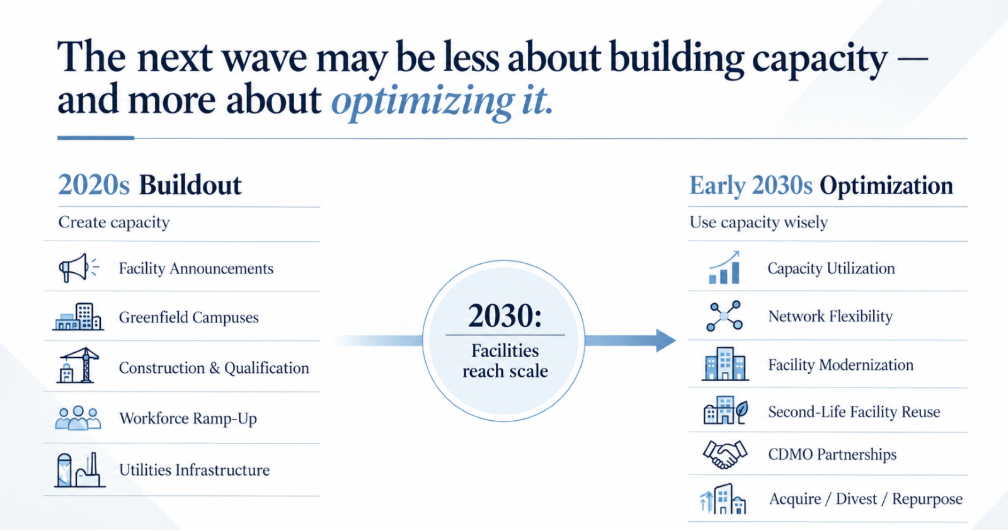
The current investment cycle is still in motion. Given that most facilities announced under the regulatory and tariff exigencies prevailing over the last few years are not yet fully operational, the industry cannot yet know whether today’s wave will produce the right amount of capacity, in the right places, for the right modalities.
By the early 2030s, the answer may become clearer. Several major manufacturers have announced multi-year U.S. investment programs extending through the late 2020s and early 2030s, meaning capacity additions, qualification activity, and product ramp decisions will likely overlap across companies and modalities. Some therapies will exceed expectations. Others will underperform. Some therapeutic platforms may require more capacity. Others may see utilization fall short of assumptions. Some facilities will become indispensable. Others may need to be repurposed, sold, partnered, or rationalized.
It’s important to remember, this does not point to a failure of the investment strategies of the 2020s. It means the industry will have entered a new phase of manufacturing strategy: capacity optimization.
The current environment is shaped by a need for more production capacity as well as some level of tax and regulatory influences which may have accelerated plans for new production capacity. But long-lead manufacturing cycles often evolve from scarcity to oversupply. This may be more likely to the extent the current wave of announced investments may have gotten out in front of market demand. As new facilities come online, the industry may discover that some therapies remain constrained while others have excess or underutilized capacity.
That risk is especially relevant because the 2020s wave spans a wide range of modalities, including API, biologics, injectables, radiopharmaceuticals, ADCs, vaccines, and other advanced therapies. Demand may scale differently across each category, leaving some networks short of capacity and others with assets that no longer match the highest-growth products. At the same time, legacy facilities built for older products or processes may face increasing pressure if they cannot be efficiently modernized or converted.
Manufacturing technology will also shape what comes after the surge of the past few years. Advanced automation, AI-enabled operations, digital twins, modular design, single-use systems, continuous manufacturing, and flexible multi-product facilities continue to change the economics of production. Facilities designed around these capabilities may have advantages over older plants built for narrower or more static processes.
That does not portend a wave of closures. Many facilities can be modernized, converted or repositioned. Some may shift to different products or roles within broader product portfolios and logistics network. Others may become attractive acquisition targets for buyers with different cost structures, technical capabilities and/or strategic priorities.
The next competitive advantage may therefore come from network flexibility: the ability to shift, acquire, partner, repurpose, or redeploy manufacturing capabilities as demand changes. That flexibility is what could make existing Good Manufacturing Practice (GMP) assets especially valuable in the next phase of the cycle.
If some facilities become underutilized, they may create new opportunities. Existing GMP manufacturing assets are difficult and expensive to replicate. Even if a facility no longer fits its original owner’s strategy, it may remain highly valuable to a CDMO, emerging biotech company, specialty manufacturer, or large pharmaceutical company seeking faster access to capacity.
Recent transactions show this market is already emerging. Lilly’s sale of its Branchburg, New Jersey site, Reckitt’s reuse of the former Sandoz facility in Wilson, North Carolina, and Novartis’s acquisition of the former Jaguar Gene Therapy facility in Durham, North Carolina point to the same trend: existing pharma manufacturing assets can sometimes be repositioned, repurposed, or absorbed into new networks faster than building from scratch, especially given the scarcity of shovel-ready sites, reliable power sources and other factors, and the time and cost of new construction. Broader pharma-to-CDMO facility sales also suggest that manufacturing-network realignment is creating expansion opportunities for buyers seeking operating GMP infrastructure.
The second-life market may include both legacy facilities and newer assets that become stranded as product strategies, platform demand, or ownership priorities change. For buyers, these assets can offer a faster and less capital-intensive path to capacity. For sellers, they create options to preserve value through sale, lease, partnership, or conversion.
The companies best positioned to benefit from the post-surge environment will not necessarily be those with the largest footprint. The winners will be those that built the most adaptable networks: facilities with room to expand, utilities that can support future growth, assets that can accommodate new technologies, strategic CDMO relationships, and the ability to acquire, divest, or repurpose capacity as demand changes.
For communities, the opportunities are different but equally important. The life sciences industry is unlikely to repeat the scale and concentration of the 2020s wave for another few decades, which means the next cycle will not be defined solely by new greenfield megaprojects. Communities that want to compete into the 2030s should prepare for a broader set of opportunities, including expansions, second-life facilities, infrastructure-backed redevelopment, CDMO partnerships, and niche capacity tied to specific modalities. The next wave of opportunities will be more diverse, less immediately visible and geographically distributed, including many “new” life sciences production markets that leveraged the 2020s surge to ramp up their talent other resources (e.g., Houston, Texas; Columbus, Ohio; Richmond, Virginia; Lehigh Valley, Pennsylvania)
That preparation should focus on the fundamentals that reduce execution risk: expandable utilities, aligned permitting processes, specialized and adaptable workforce pipelines, and a clear strategy for repositioning existing industrial or life sciences assets as manufacturing needs evolve.
The 2020s were about creating capacity. The early 2030s will be about using capacity wisely.
Taken together, this series shows that the 2020s pharma manufacturing surge was more than a wave of capacity announcements. It began with the forces that made U.S. manufacturing more strategically important: therapeutic innovation, patient demand, tax reform, industrial policy, and federal pricing and trade pressure. It then revealed what the wave required in practice: workforce scalability, site readiness, utility certainty, permitting alignment, and public-sector execution. Looking ahead, the next strategic question is what happens when today’s facilities reach scale and the challenge shifts from creating capacity to operating at scale and adapting to evolving market, technology and other variables.
The companies and communities that come out ahead will not simply be those that move fastest. They will be those that build adaptable manufacturing networks, invest in the fundamentals that reduce execution risk, and remain ready to expand, repurpose, acquire, divest, or reposition capacity as the industry moves into its next cycle.
For companies, communities and public-sector partners navigating the next wave of pharmaceutical manufacturing investment, having the right location strategy is critical. Since 2020, BLS has advised leading pharmaceutical manufacturers, including Lilly, Genentech, AbbVie, Johnson & Johnson and Bristol Myers Squibb, on major projects representing more than $60 billion in new investment across the United States.
Whether planning a new facility, expanding an existing operation or positioning a community for future investment, BLS’s location advisory team can help identify the right opportunities, mitigate project risk and turn location strategy into a competitive advantage.
Contact BLS to discuss how these trends could shape your next investment or economic development strategy.
Jay Biggins, Executive Managing Director, and Kyle Syers, Senior Manager, are trusted advisors to global pharmaceutical companies pursuing large-scale manufacturing investments. Their experience includes supporting location and incentives strategies for Eli Lilly, Bristol Myers Squibb, Biogen, AbbVie, Johnson & Johnson, and Genentech. Since 2020, their work to help organizations navigate complex site selection, workforce, infrastructure, and incentives considerations has contributed to more than 20 announced pharmaceutical manufacturing projects representing over $60 billion in capital investment.
Jay is the Executive Managing Director at Biggins Lacy Shapiro & Co., one of the most highly regarded site selection and incentives advisory firms in North America. BLS & Co. helps manage the complexities associated with finding optimal locations and securing incentives to support new ventures.
Since joining the firm in 2015, Kyle has worked with clients in various capacities in the firm’s site selection and incentive advisory practices to optimize value in location decisions for client projects including headquarters, data centers, office and industrial facilities.
We're on a mission to help companies of all sizes identify the best locations, secure incentives, obtain development approvals and optimize energy strategies through Location Economics®.
BLS & Co. serves as location and incentives advisor to Roche, Swiss multinational healthcare leader, and its subsidiary Genentech, the South San Francisco-based biotechnology industry leader. Our engagements with Roche date back to 2012, supporting over $2.7 billion in announced investments.
BLS & Co. serves aslocation and incentives advisor to Roche, Swiss multinational healthcare company, and its subsidiary Genentech, the South San Francisco-based biotechnology industry leader. Our engagements with Roche date back to 2012 with four major projects announced as of 2026:
BLS & Co. utilizes an assortment of services – a process we call Location Economics® – to advise clients on location decisions. Discover our variety of offerings to help you navigate the complex decision making processes that occur when searching for a new location for your organization.
BLS & Co. specializes in a variety of industries and our dedicated team is compromised of experts in nearly all major categories.
At BLS & Co., we have executed wide variety of projects for our clients, which includes facilities such as headquarters, warehouses, and data centers.
Stay up to date with BLS & Co. by exploring our latest news and musings on the world of site selection and more.
We're proud to provide a few key resources to help get you started on your site selection journey.
Search our North American database for the right location for your company's HQ, R&D Facilities, and more.
Browse our regional resource guide for site selection in the U.S.
If your organization is confronting complex and sensitive location decisions, please reach out to schedule a confidential conversation.
Interested in a career opportunity with BLS & Co.? Click below to learn more about our growing team and view all current openings.


